
Security
LiveUXI is delivered as a managed platform, so security is considered alongside hosting, deployment, support, monitoring, user access, operational review, and ongoing change. The aim is to give your organisation a clearer operating model rather than a standalone security checklist.
Security-conscious platform delivery
LiveUXI is designed to be delivered as a managed platform, with security hardening, controlled change, role-based access, and operational ownership considered from the start of the rollout.
Operational monitoring and maintenance
We maintain the platform through updates, environment reviews, platform housekeeping, and incident-aware support processes so your system can stay healthier as it evolves.
Data visibility and accountability
Activity tracking, logs, operational visibility, and managed workflows can help your organisation understand what changed, who acted, and where attention may be required next.
Practical controls, not empty jargon
Security is treated as a working operational discipline: environment hygiene, credential handling, access boundaries, deployment discipline, backup planning, and sensible review points.
Clear activity records without exposing sensitive data.
LiveUXI is designed to help teams understand important actions, role-based visibility and support activity using operational records that can be reviewed when needed. The exact level of visibility depends on the modules, permissions and configuration agreed for your platform.
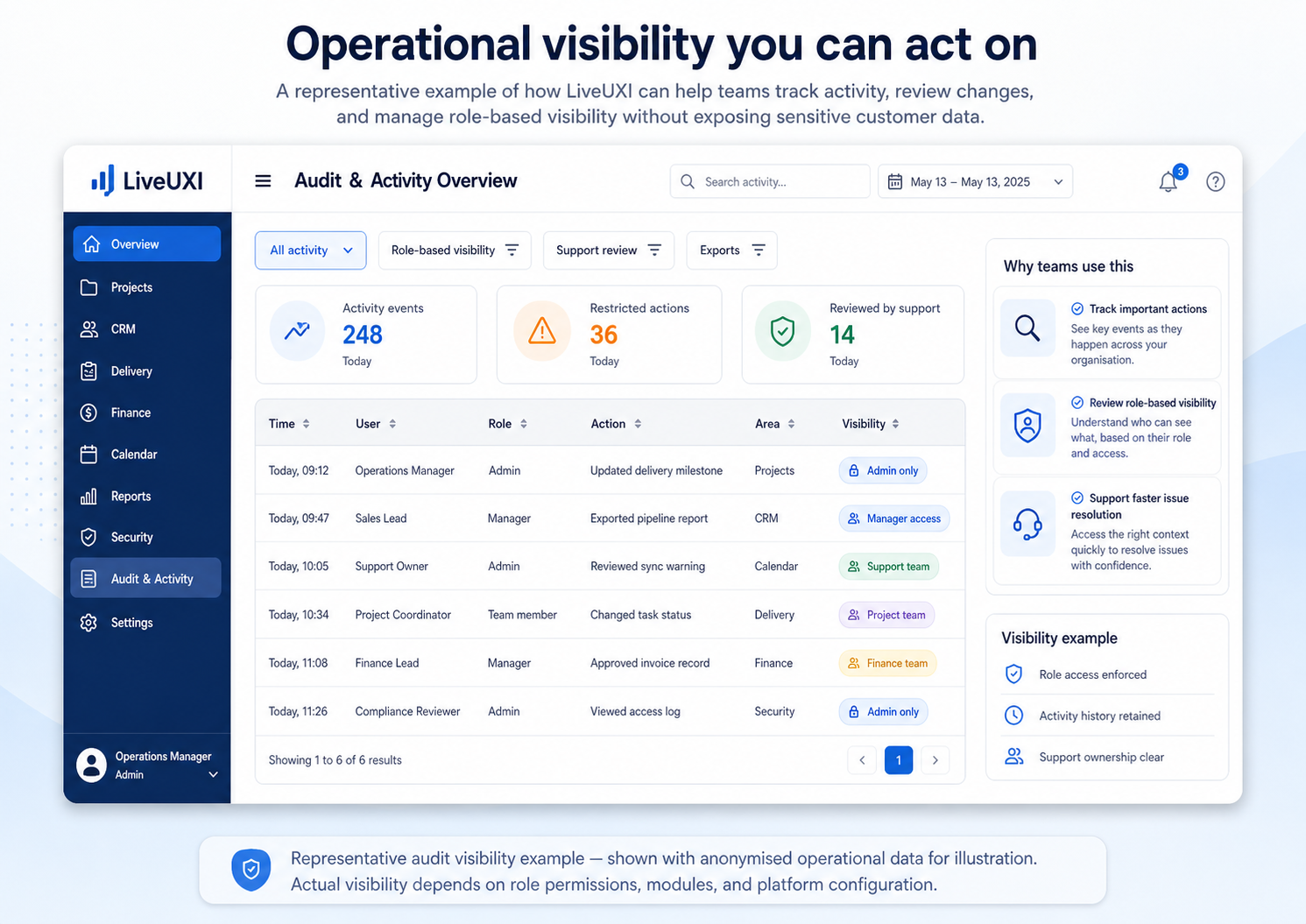
How security is handled in practice.
For buyers, the important question is how security is delivered, maintained, monitored and supported once real users, data, change requests and business deadlines are involved.
Access and permissions
- Role-aware access can be applied to platform areas and business workflows
- Administrative functions can be restricted to reduce unnecessary exposure
- User expansion can be reviewed through plan allowances and operational requirements
Application and platform hardening
- Managed updates and environment maintenance are part of the delivery approach
- Infrastructure and supporting services can be reviewed as part of the operating model
- Public systems and client workloads are approached with a security-minded hosting posture
Backups and recoverability
- Backup and restoration planning can form part of managed delivery
- Staged environments and rollout discipline help reduce avoidable deployment risk
- Recovery expectations can be discussed and scoped around your operational needs
Monitoring and review
- Monitoring, logging and operational visibility can be included as part of the managed platform offer
- Issues can be triaged through support and service workflows
- Security-sensitive organisations can extend their posture with advanced monitoring and support add-ons
Need a more security-conscious rollout?
If your organisation needs stronger monitoring, stricter operational controls, additional environments, or a bespoke DevOps and security delivery model, LiveUXI can be scoped accordingly through platform tiering, add-ons and specialist work.
- Review delivery scope
- Map access and environment needs
- Confirm support posture
- Price any uplift cleanly
Frequently asked questions
How does LiveUXI handle access control?
LiveUXI is designed around role-aware access, so users only see the areas and workflows that are relevant to their responsibilities. Administrative areas can be restricted, user access can be reviewed during rollout, and permission design can be shaped around your operating model.
Can we use two-factor authentication?
Yes. LiveUXI can support stronger sign-in controls such as two-factor authentication where required, helping add another layer of protection for teams accessing sensitive operational systems.
What monitoring is included?
Monitoring and operational review are part of the managed platform approach. The exact level depends on the plan, configuration and support posture, but LiveUXI is designed so platform health, issues and security-sensitive activity can be reviewed and acted on through support processes.
Are backups and recovery planning included?
Backups and recoverability are treated as part of managed delivery rather than an afterthought. The backup approach, restoration expectations and any enhanced recovery requirements can be confirmed during implementation and commercial scoping.
Can we see what changed inside the platform?
LiveUXI is designed to support activity tracking, logs and operational visibility so teams can understand important actions, who made them, and where attention may be needed. The level of audit visibility depends on the modules enabled, user roles and agreed configuration.
How does LiveUXI support governance requirements?
LiveUXI can be aligned to internal governance needs such as access boundaries, operational ownership, support processes, change review and documentation expectations. Formal legal, regulatory or certification work should still be handled with the relevant specialists where required.
Do you offer compliance advice?
We provide a security-conscious delivery approach and can align platform rollout to business, governance and documentation needs. Formal legal or regulatory certification work should still be handled with the relevant specialists where required.
Can security be enhanced beyond the standard plans?
Yes. LiveUXI supports stronger support posture, advanced security monitoring, environment expansion, and bespoke DevOps or security work where the business needs more depth.
Is security handled separately from hosting and support?
No. Security is strongest when it is tied into hosting, deployment, maintenance and support. That is why LiveUXI positions security as part of managed delivery rather than as a disconnected bolt-on.
Can we discuss our own internal requirements?
Yes. If you have internal standards, supplier review requirements, or sector-specific expectations, we can shape the delivery and operating model around them during implementation and commercial scoping.
Need to validate security, governance or operational fit?
You can review LiveUXI’s wider compliance position, then discuss access, monitoring, support ownership, change visibility and rollout expectations before committing.
See how governance, controls and responsible platform operation are framed.
Share your internal security, access, monitoring or supplier-review expectations.
Review how support, maintenance and operational responsibility fit into managed delivery.