Compliance & governance

A practical compliance posture for modern delivery

LiveUXI is designed to support secure delivery, clear accountability, and enterprise-grade operational habits. This page gives security-aware buyers a public baseline for access control, authentication, auditability, hosting posture, support ownership, rollout governance, and public trust claims.

Security-first delivery

Every public-facing build should begin with sane defaults: least privilege, controlled access, change visibility, and secure operational habits.

Data minimisation

We prefer collecting only what is required for the workflow, storing it clearly, and reducing unnecessary duplication across systems.

Operational accountability

Teams need visibility into what changed, who changed it, and what to do next when something drifts or fails.

Practical governance

Compliance should support delivery, not block it. The platform is designed to make governance visible and manageable.

Governance operating model

This diagram shows how LiveUXI connects identity, logging, audit trails, controls, support ownership and change management into one governance view.
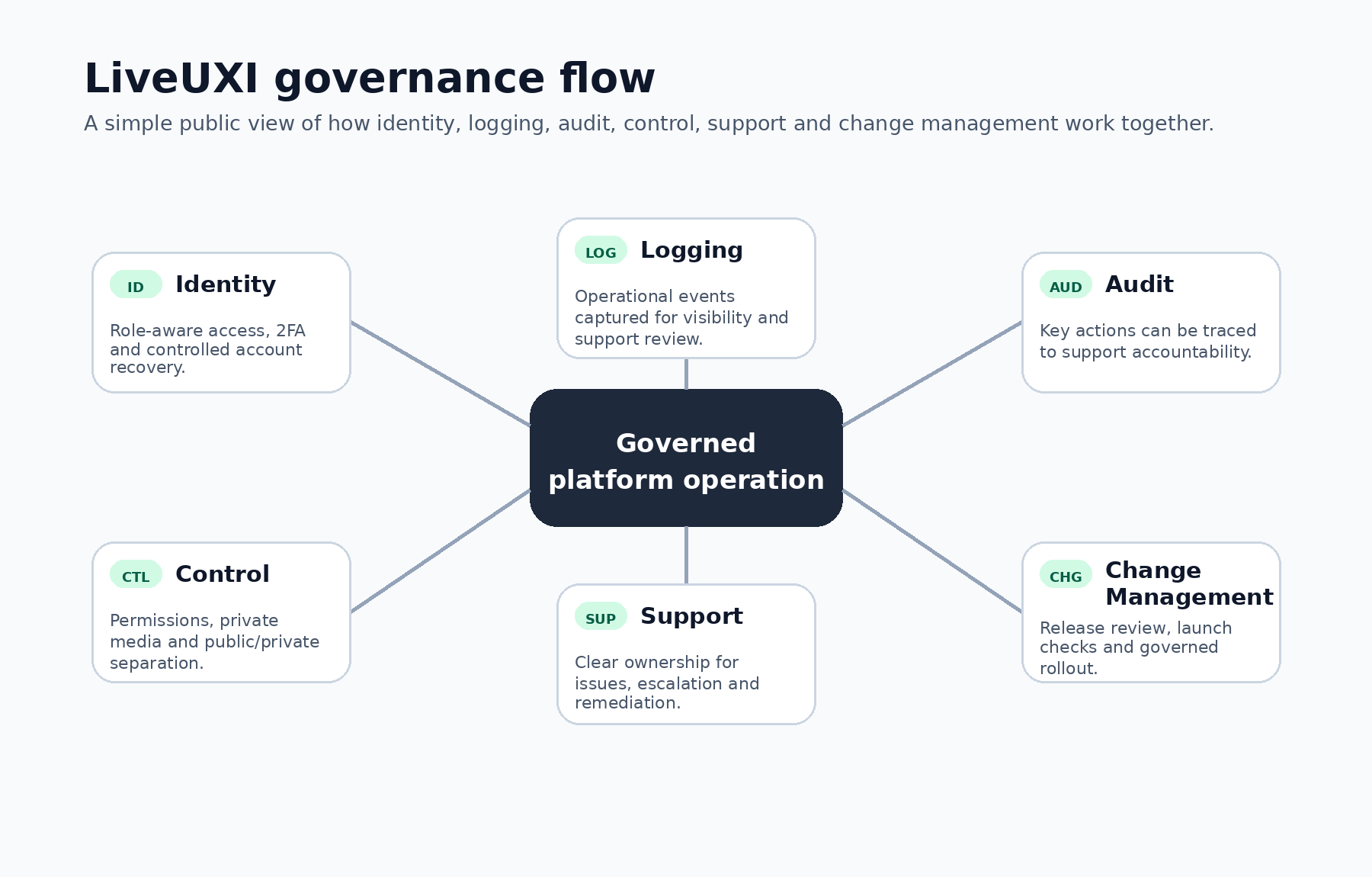
Diagram showing LiveUXI governance flow across identity, logging, audit, control, support and change management

Compliance and governance areas

The following areas define the public compliance posture of the LiveUXI platform. Each section outlines how access, authentication, auditability, hosting, support, and operational governance are approached at a platform level.

Access control

LiveUXI is designed around permission-aware access, separation of public and private areas, and least-privilege operational habits.

  • Role-aware access for internal platform areas
  • Separation between public website content and private business tooling
  • Approval-led access where client or operational workflows require it
  • Permission-aware handling for sensitive records, media, and administrative actions

Two-factor authentication

Enterprise deployments should use strong authentication rather than relying on passwords alone.

  • Support for authenticator-app based 2FA workflows
  • Clear login and account recovery expectations
  • Controlled administrative reset paths
  • Suitable for teams that require stronger identity controls

Audit trails

Important operational actions should be traceable so teams can understand what changed, who changed it, and when.

  • Audit-friendly workflows for platform changes
  • Traceability for booking, calendar, sync, integration, and support-sensitive actions
  • Support for reviewing failed or drifted operational processes
  • Structured logs and records that help support, remediation, and incident review

Hosting posture

The platform is intended to run in a managed, monitored hosting environment with sensible production controls.

  • HTTPS-first public delivery
  • Operational monitoring for web, PHP, queue, and realtime services
  • Backup and recovery expectations
  • Environment separation for live and pre-live workflows where required

Support ownership

Enterprise buyers need to know who owns support, escalation, and operational follow-up.

  • Clear support contact paths
  • Defined ownership for platform, hosting, and implementation issues
  • Escalation for operational, access, or security-sensitive concerns
  • Support notes and recovery guides for critical workflows

Rollout governance

Changes should move through review, sign-off, and release checks rather than being shipped as unfinished placeholders.

  • Pre-launch review for content, media, SEO, CTAs, and trust claims
  • Controlled use of Blade overrides versus builder-managed content
  • No public compliance claims without supporting evidence
  • Governed rollout for client-specific configuration and modules

Data handling

Data governance should reduce unnecessary exposure, duplication, and unclear ownership.

  • Structured page metadata and content ownership
  • Permission-aware storage design for sensitive assets
  • Reduced spread of duplicated content and uncontrolled copies
  • Support for retention and governance policies where required

Public claims and limitations

LiveUXI separates platform capabilities, configurable controls, and formal compliance work so buyers can understand what is available by design

What LiveUXI provides

  • A modular Laravel and Livewire platform for public websites, internal business tools, calendars, bookings, workflows, media, integrations, and operational dashboards.
  • Governance-friendly patterns for access control, audit visibility, support workflows, page ownership, and controlled rollout.
  • A public trust layer that explains the platform posture without exposing private infrastructure or client-specific procedures.

What can be configured

  • Access roles, module availability, page ownership, booking rules, approval flows, integration settings, support paths, and client-specific operational workflows.
  • Public trust pages, security messaging, support content, launch checks, media handling, metadata, and internal governance records.
  • Sector-specific controls can be added where a deployment needs stronger evidence, stricter approvals, or additional record keeping.

Common questions

These are the questions that usually sit behind a serious front-end, security, and platform review.

LiveUXI does not claim formal certification on this page. The platform is designed with governance, access control, auditability, and operational visibility in mind, but formal frameworks such as SOC 2 or ISO 27001 require additional implementation, documentation, and external validation specific to each deployment.
Yes. LiveUXI is modular and configurable, allowing access controls, workflows, record keeping, and operational processes to be shaped around your organisation’s requirements. Any formal compliance obligations should be validated against the specific deployment, hosting model, and data flows.
The platform supports role-aware access patterns, separation between public and private systems, and strong authentication approaches such as 2FA. These controls can be configured to match internal policies and governance expectations.
LiveUXI is designed to support traceability of key actions, including operational changes, workflows, and system events. This enables teams to review activity, investigate issues, and maintain accountability across platform usage.
Hosting posture, monitoring, backups, and operational controls depend on the deployment model. LiveUXI supports a structured and monitored environment, but responsibility for infrastructure, security controls, and ongoing operations should be clearly defined as part of the implementation.
Security, procurement, and governance teams can request a review using the contact options on this page. This can include discussions around access models, audit posture, hosting approach, support ownership, and enterprise roadmap considerations.

Security or governance questions?

Procurement, security, and enterprise teams can request a focused review of LiveUXI’s access model, audit posture, hosting approach, support ownership, rollout governance, or enterprise roadmap.

Useful review paths

  • Security review: Review access, authentication, audit trails, hosting posture, and operational controls.
  • Governance questions: Clarify support ownership, rollout governance, public claims, and client-specific requirements.
  • Enterprise roadmap call: Discuss future modules, integrations, compliance needs, and deployment expectations.